Learn the valves, operators, and controls that run a plant
A self-paced course that starts with what a valve is and ends with you choosing the right valve and operator for a real service. No brand names, just how the equipment works and where it belongs.
How the course works
Read the key ideas
Each module is 25 to 45 minutes: a short list of ideas in plain language, a side-by-side table where it helps, and a tip from the field.
Try it on real equipment
Every module ends with something to do in a mechanical room, a plant, or on a drawing, so the terms attach to hardware.
Check your understanding
A short quiz closes the module. Miss no more than one and it is marked complete. Explanations show either way.
Keep your own pace
The schedule suggests one unit a week for six weeks. Modules stand alone, so skip ahead to what you need tomorrow.
Course schedule
Five units, in the order the ideas build. Module numbers follow the unit: F for foundations, V for isolation valves, S for special duty, A for actuation, X for everything beyond the valve.
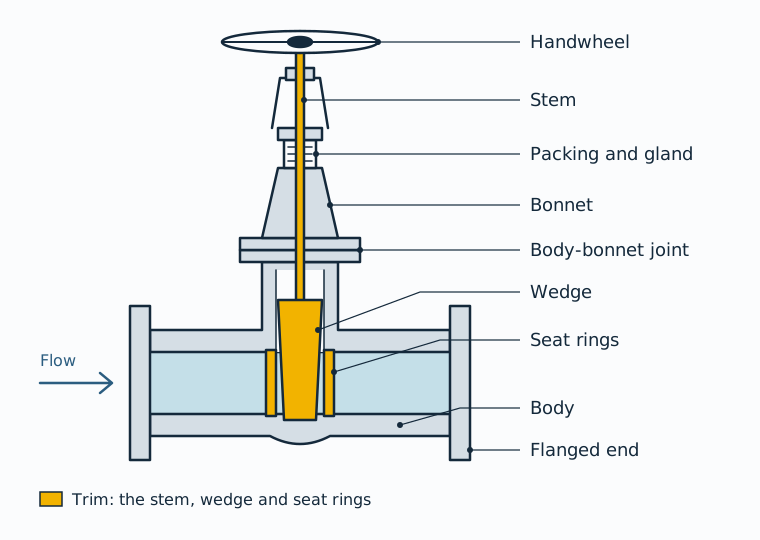
Every valve has the same few parts
A shell that holds pressure, a closure member that moves, seats it seals against, a stem that moves it, and packing where the stem leaves the shell. Module F-101 walks through each one.
Symbol sheet
The schematic symbols used through the course, drawn the way they appear on a piping and instrumentation diagram. Module F-103 covers how to read them.